The history of San Miguel de Allende is not confined to archives, museums, or monuments. It can be seen in the layout of its streets, the proportions of its historic homes, and an architectural legacy that continues to shape the city's identity.
The history of San Miguel de Allende is not confined to archives, museums, or monuments. It can be seen in the layout of its streets, the proportions of its historic homes, the courtyards hidden behind their façades, and an architectural legacy that continues to shape the city's identity.
Founded in the 16th century, San Miguel emerged at a strategic point within New Spain and became connected to the Camino Real, the extensive route that linked important mining and commercial centers for centuries. Its location encouraged the movement of people, goods, and ideas, and by the 18th century, the city had entered one of the most prosperous periods in its history.
That past left a legacy that remains visible today. Yet one of San Miguel's defining qualities is that its history never feels like a static backdrop. The city has preserved its heritage while continuing to evolve, allowing different periods to coexist within the same contemporary experience.
A City Shaped Over Time
Much of San Miguel's character can be understood through its architecture. As the city developed, churches, residences, and civic buildings reflected both its growing prosperity and the cultural influences reaching this part of Mexico. UNESCO particularly recognizes its grand urban residences and the architectural transition from Baroque to Neoclassical styles—an exceptional richness for a city of its scale.
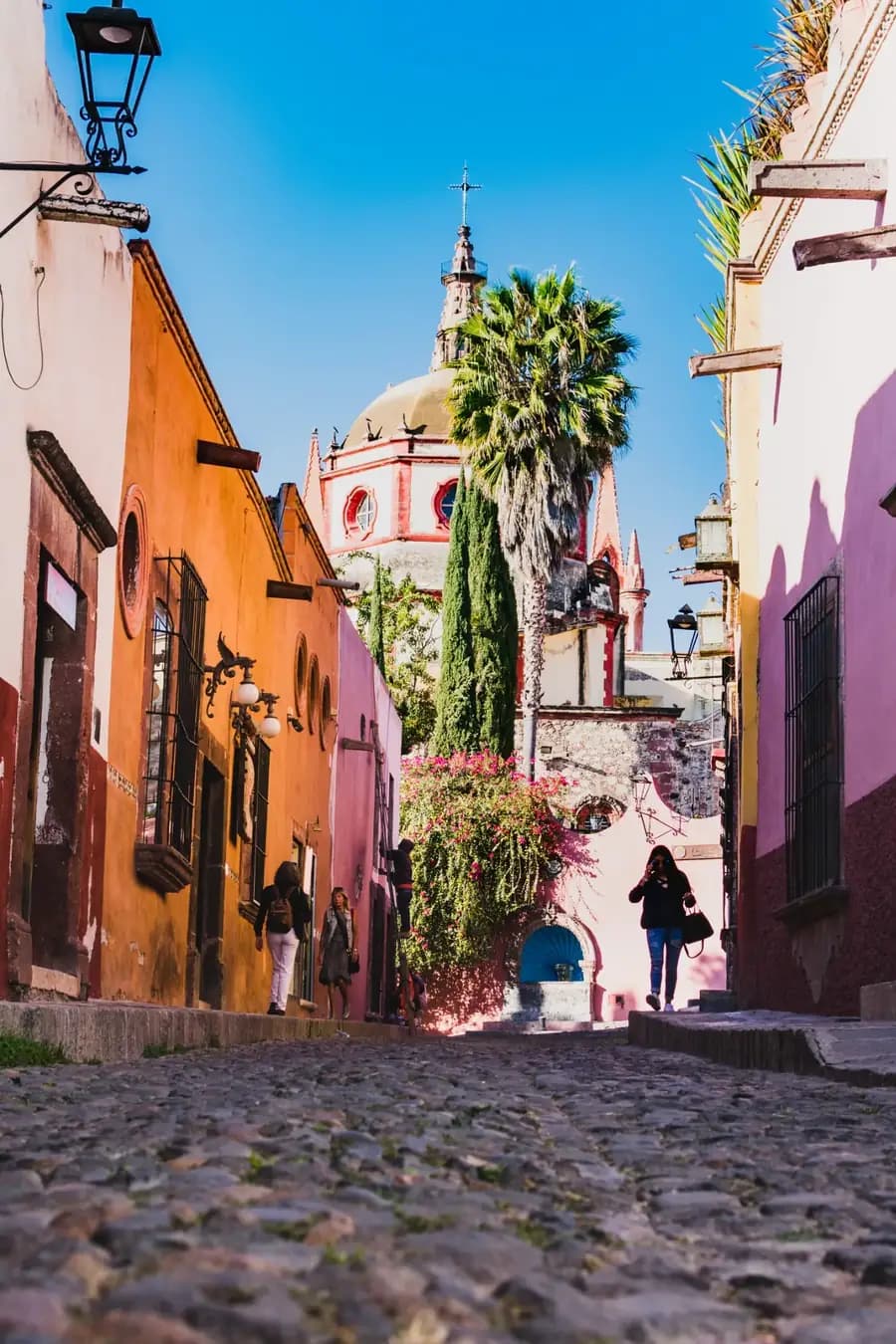
That legacy continues to define the urban landscape. Stonework, interior courtyards, wooden doors, and warm-toned façades create a distinctive visual identity, but their significance goes beyond aesthetics. Many of these spaces remain closely connected to contemporary life.
Historic buildings now house hospitality concepts, restaurants, galleries, and design spaces. Architecture created centuries ago is therefore not simply preserved; it continues to find new purpose within a city whose identity is still evolving.
Walking through San Miguel makes this relationship particularly clear. History appears at every turn, yet rarely feels removed from the present.
A History Connected to Mexico's Identity
San Miguel also holds an important place in the history of Mexican Independence. Its location in the Bajío region, along with the involvement of prominent figures born in the city, connected it directly to the insurgent movement that began reshaping the country in the early 19th century.
Among them was Ignacio Allende, whose surname would eventually become part of the city's name. His family home, an 18th-century residence facing the main square, is now the Museo Histórico Casa de Allende and remains one of the places where this chapter of Mexican history can be explored in the setting where it began.
Yet San Miguel's historical importance extends beyond a single figure or event. Its identity developed through different periods, each leaving architectural, religious, and cultural expressions that can still be recognized throughout the city.
This sense of continuity makes it possible to encounter history without separating it entirely from the present.
The Landmark That Redefined the City Skyline
Among San Miguel's many historical layers, one image has become its most recognizable symbol: the Parroquia de San Miguel Arcángel.
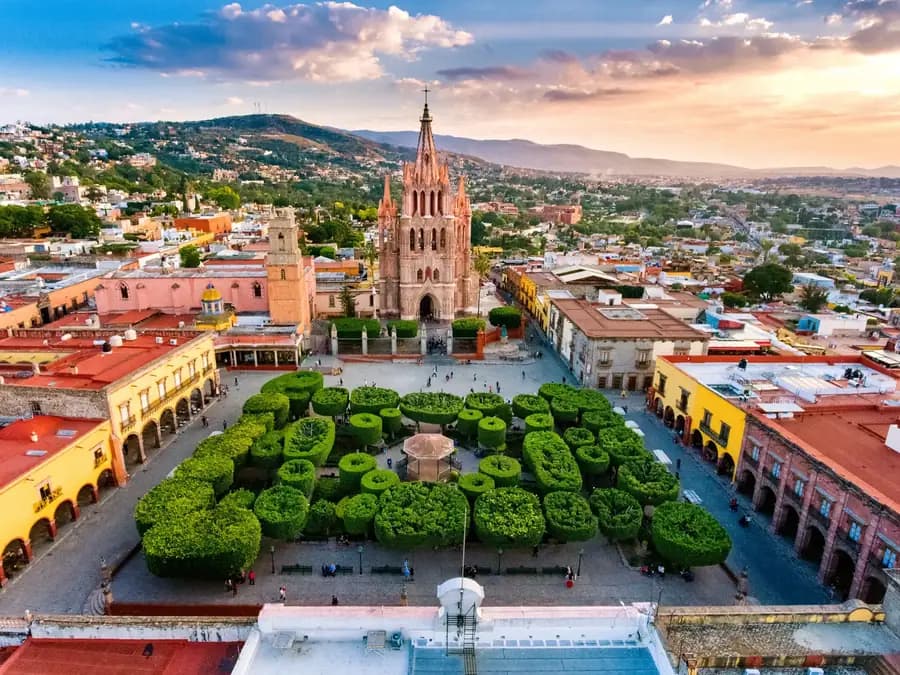
The church dates back to the 17th century, but the silhouette that now defines the historic center arrived much later. In 1880, Zeferino Gutiérrez redesigned its pink stone façade with a strong European neo-Gothic influence. The transformation permanently changed San Miguel's skyline and became one of the clearest examples of how different periods have added their own interpretation to the city.
From the surrounding streets, the Parroquia appears between façades, balconies, and rooftops. From terraces and elevated viewpoints, its towers rise prominently above the historic center. Its importance lies not only in its architecture, but also in the way it has become woven into San Miguel's everyday identity.
Life continues to unfold around it, allowing a landmark with centuries of history to remain an active part of the city's present.
A Heritage That Extends Beyond the Historic Center
San Miguel's history reaches beyond the city itself. A short distance away stands the Sanctuary of Jesús Nazareno de Atotonilco, whose architecture and extensive mural paintings represent one of the most remarkable expressions of Mexican Baroque art. The cultural significance of both places led UNESCO to inscribe the Protective Town of San Miguel and the Sanctuary of Jesús Nazareno de Atotonilco as a World Heritage Site in 2008.
The designation helps place the destination's architectural and historical importance into perspective, but it also reflects something that becomes evident when experiencing San Miguel firsthand. Its heritage is not defined by a collection of isolated landmarks. It is found in an urban environment where architecture, public spaces, and landscape have remained connected across generations.
That continuity is part of what allows San Miguel to preserve such a strong sense of identity, even as contemporary life continues to transform the city.
Preserving the Past Without Remaining in It
Perhaps one of the most compelling aspects of San Miguel de Allende is its ability to evolve without losing the qualities that make it distinctive.
Historic buildings now exist alongside contemporary expressions of art, design, gastronomy, and hospitality. Streets once connected to important commercial routes are now explored by a diverse community, while plazas, churches, and courtyards continue to serve as gathering places.
This coexistence keeps history from becoming something that is simply observed from a distance. It can be experienced by entering a historic home, walking along a stone street, discovering an interior courtyard, or seeing how centuries-old architecture continues to provide a setting for new expressions of the city.
San Miguel de Allende has transformed repeatedly throughout its history, and that evolution is precisely what keeps its heritage relevant. Preservation here is not about holding on to an untouched image of the past, but about allowing each generation to build a new relationship with it.
To understand San Miguel is to recognize these different layers: those that shaped its beginnings, those that transformed its architecture, and those that continue to write its story today.
Because in San Miguel, the past is not simply something that happened. It remains part of how the city is experienced today.